Benchmark
pip install "flodr[paper]"python examples/benchmark.pyexamples/benchmark.py fits FloDR,
FloDR without the distance order (w=0), UMAP, openTSNE and PCA to two data sets, three seeds each: the 2,730 bone
marrow cells of paul15 and 10,000 Fashion-MNIST images, both as 50 standardised principal components. It scores each
map by the share of the 15 nearest input neighbours of a point that stay among its 15 nearest on the map (recall@15,
local structure) and by the rank correlation of input and map distances over 500,000 random pairs (CPD, global
structure). It takes about seven minutes with a GPU.
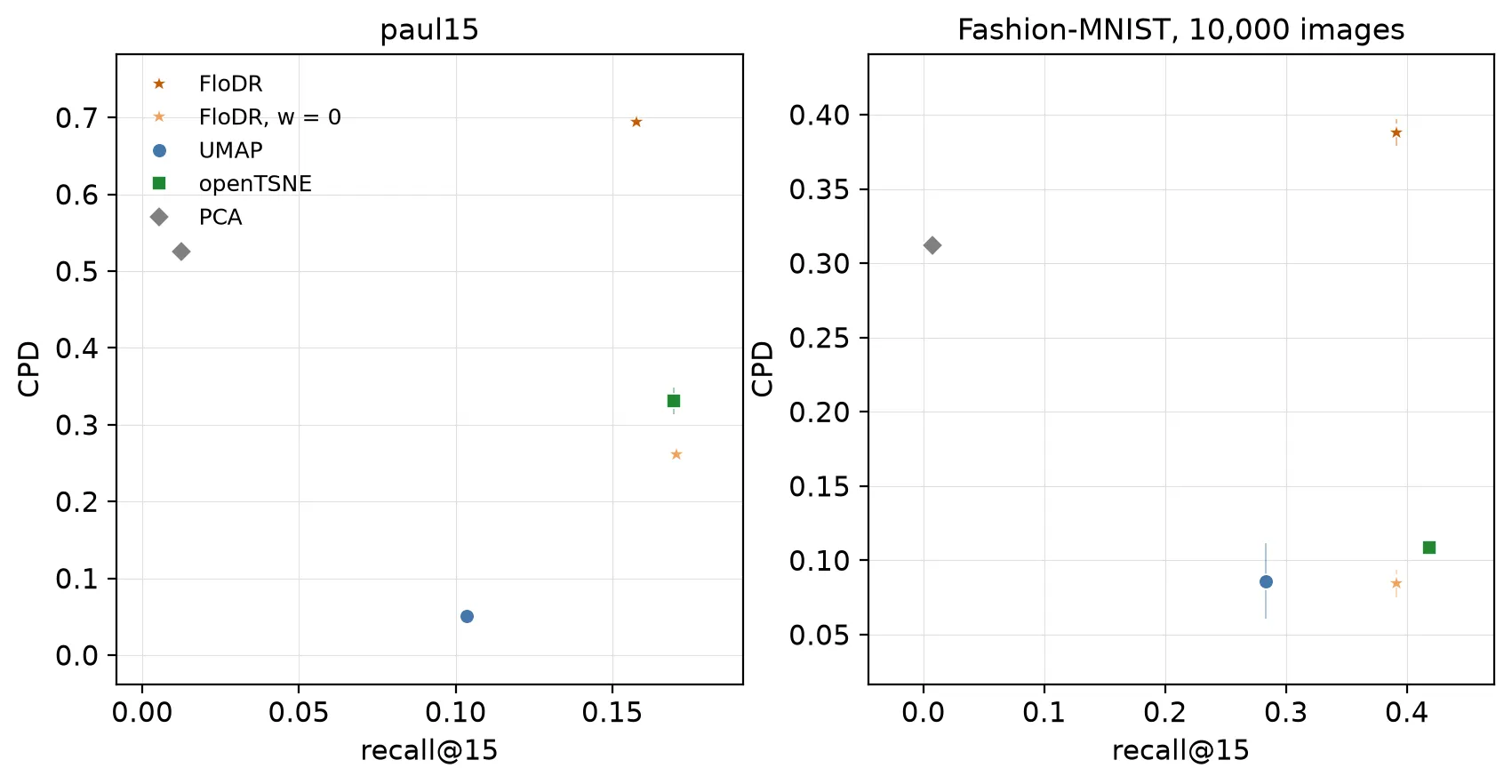
FloDR keeps the most global structure on both: CPD 0.70 on paul15, against 0.33 for openTSNE and 0.05 for UMAP, and
0.39 on Fashion-MNIST, against 0.11 and 0.09. Its recall is within 0.03 of the best, openTSNE (0.419 against 0.391 on
Fashion-MNIST). Without the distance order its CPD falls to that of the neighbour methods (0.26 and 0.08), so the gain
comes from the term weighted by w. PCA keeps distances but loses neighbourhoods.
The script
from pathlib import Path
import matplotlib.pyplot as pltimport numpy as npimport scanpy as scfrom openTSNE import TSNEfrom scipy.stats import spearmanrfrom sklearn.datasets import fetch_openmlfrom sklearn.decomposition import PCAfrom sklearn.neighbors import NearestNeighborsfrom umap import UMAP
from flodr import FloDR, viz
OUT = Path(__file__).resolve().parents[1] / "docs" / "docs" / "images"SEEDS = (0, 1, 2)

def standardised_pcs(X):    P = PCA(50, svd_solver="randomized", random_state=0).fit_transform(X)    return ((P - P.mean(0)) / P.std(0)).astype(np.float32)

def paul15():    a = sc.datasets.paul15()    sc.pp.filter_genes(a, min_counts=1)    sc.pp.normalize_total(a, target_sum=1e4)    sc.pp.log1p(a)    sc.pp.highly_variable_genes(a, n_top_genes=1000, subset=True)    sc.pp.scale(a, max_value=10)    return standardised_pcs(np.asarray(a.X, np.float64))

def fashion_mnist(n=10000):    X = fetch_openml(        "Fashion-MNIST", version=1, return_X_y=True, as_frame=False, parser="liac-arff"    )[0]    return standardised_pcs(X[np.random.default_rng(0).permutation(len(X))[:n]])

METHODS = {    "FloDR": lambda X, s: FloDR(random_state=s, verbose=False).fit_transform(X),    "FloDR, w = 0": lambda X, s: FloDR(        w=0, random_state=s, verbose=False    ).fit_transform(X),    "UMAP": lambda X, s: UMAP(init="pca", random_state=s).fit_transform(X),    "openTSNE": lambda X, s: np.asarray(TSNE(random_state=s, n_jobs=8).fit(X)),    "PCA": lambda X, s: PCA(2).fit_transform(X),}STYLES = {    "FloDR": ("#c25e08", "*"),    "FloDR, w = 0": ("#f0a35e", "*"),    "UMAP": ("#4477AA", "o"),    "openTSNE": ("#228833", "s"),    "PCA": ("0.5", "D"),}

def scores(X, Y, k=15, pairs=500_000):    # recall@15 of input neighbours, and the rank correlation of distances (CPD) over    # random pairs    a, b = (        NearestNeighbors(n_neighbors=k + 1).fit(Z).kneighbors(Z)[1][:, 1:]        for Z in (X, Y)    )    recall = np.mean([len(set(p) & set(q)) for p, q in zip(a, b)]) / k    i, j = np.random.default_rng(0).integers(0, len(X), (2, pairs))    d = [np.linalg.norm(Z[i] - Z[j], axis=1) for Z in (X, Y)]    return recall, spearmanr(*d)[0]

plt.rcParams.update(viz.RC)fig, axes = plt.subplots(1, 2, figsize=(10, 4.6))for ax, (name, X) in zip(    axes, (("paul15", paul15()), ("Fashion-MNIST, 10,000 images", fashion_mnist()))):    results = {}    for method, fit in METHODS.items():        runs = [scores(X, fit(X, s)) for s in SEEDS]        results[method] = tuple(zip(*runs))        recall, cpd = np.mean(runs, 0)        print(f"{name}, {method}: recall {recall:.3f}, CPD {cpd:.3f}")    viz.plot_frontier(results, STYLES, ax)    ax.set_title(name)axes[0].legend(frameon=False, fontsize=9)viz.save(fig, OUT / "frontier.png", dpi=200)